

Toolpath notes
Lens care on the coast
Salt haze and damp mornings fog laser optics faster than most shops think. A short daily routine keeps your power where it should be.
Why coastal shops lose power without noticing
Every few weeks a sign shop from Durban or Gqeberha phones us with the same story. The laser that cut 3mm acrylic in one pass in winter now needs two passes, the edges look cloudy and someone has already turned the power up to 85 percent to compensate. Nine times out of ten the tube is fine. The problem is a lens that has a thin film on it, made up of salt haze, damp and a little bit of smoke residue that baked on during a long run.
Inland shops get dust. Coastal shops get dust plus moisture, and that mix is worse because it sticks. When the morning air is heavy and the workshop has been closed all night, condensation can form on cold optics the moment you fire up the extraction and pull warm, wet air across the head. Cut straight away and you are firing through a fogged lens. Its not dramatic, the beam still works, but you lose sharpness, you lose power and over time the coating gets damaged.
A morning lens check that takes five minutes
We ask every shop near the sea to treat the lens check like opening the till. It is part of starting the day, not a job for when things go wrong. Here is the routine Jacques runs at our Baywest and Pavilion demo cells.
- Switch on the room and extraction first, then wait ten minutes before you cut, so the head can come up to room temperature.
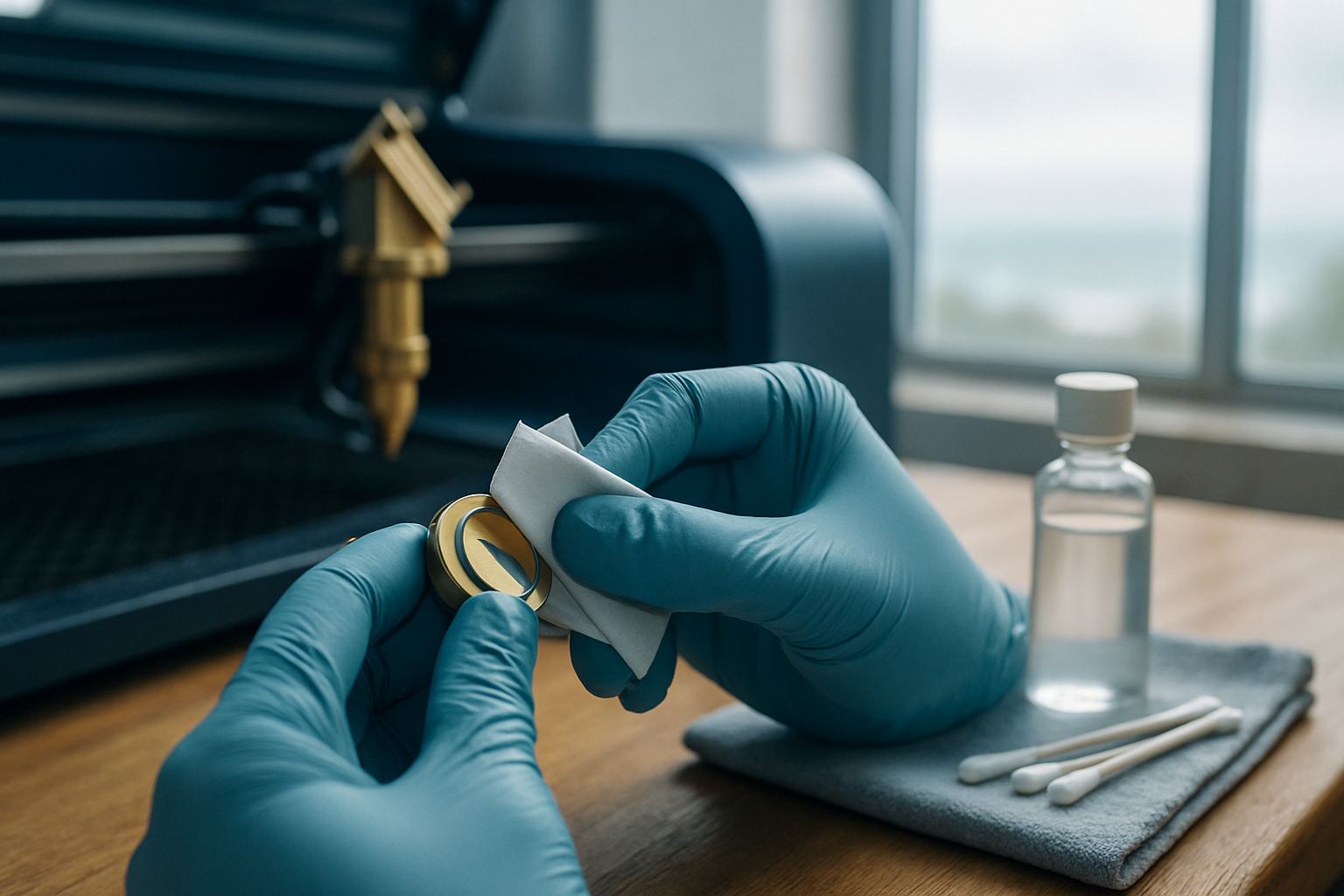
- Pop the lens holder out and look at the lens against a white light. A faint rainbow sheen or grey spots mean it needs a clean.
- Blow off loose grit with a clean air bulb, never with the shop compressor, because that line often carries oil and water.
- Wet a fresh lens tissue with optics-grade isopropyl, drag it across once in one direction, then throw it away. Don't scrub in circles.
- Check the three mirrors the same way. Mirror two and three get missed most because you have to open a cover.
- Refit with the curved side the right way up, then run a small focus ramp on scrap before the first paid job.
Keep a little card next to the machine where the operator ticks the date and writes one word, clean, sheen or spots. After a month you can see exactly how fast your shop dirties optics, and you stop guessing.
Air assist and storage habits that keep salt off
Air assist protects the lens from smoke, but on the coast it can also blow wet air straight onto it. If your compressor sits in a damp corner, fit a small inline water trap and a filter, and drain the tank at the end of every day. A lot of shops in Durban North and Umhlanga keep a seperate small oil-free compressor just for the laser, and honestly it pays for itself in lenses.
When the shop closes, close the lid and if you can, keep the machine in a room that does not drop too cold overnight. A cheap dehumidifier in a small cutting room makes a big difference through February and March, when humidity sits high for days. Some Cape Town shops near the harbour put a sachet of silica gel inside the electronics bay as well, which helps with corrosion on the rail and the head screws.
Store spare lenses in their original case, not loose in a drawer with the allen keys. We have seen good lenses scratched before they were ever fitted. Write the date you opened each one on the box so you know how long it actually lasted.
When cleaning is not enough anymore
A lens can only be cleaned so many times. If you see pitting, a burnt spot in the middle or the coating lifting at the edge, it is time to replace it, no matter how new it is. Running a damaged lens heats it up more, which damages it faster, and occasionaly it cracks mid job and can mark the head. For busy coastal shops cutting acrylic letters and wood gifts every day, a lens lasting six to nine months is normal. Inland shops often get longer.
Mirrors last longer but follow the same rule. Once the gold or silver surface looks cloudy after cleaning, swap it. Then do a full beam alignment, because a new mirror that sits a fraction off will cost you more power than the old dirty one did.
Keep a spare lens and at least one spare mirror on the shelf before December. Prize-giving runs and year end gift orders are the worst time to wait for a courier from Johannesburg.
Bring it in or send us a message
If you have cleaned everything and your cuts are still weak or cloudy, the cause might be alignment, a tired tube or water chiller temperature, and that is easier to sort with the machine in front of us. Bring a sample of the job and the lens in its holder to Baywest, Pavilion or Tyger Valley, or use our contact form and tell us your town, your machine and what changed. Our warranty and care notes list which optics are covered and which are wear parts, so it is worth a look before you order anything.
- Cuts that need more power than they did a month ago
- Cloudy or frosted edges on cast acrylic that used to come out clear
- Lenses that look dirty again a day or two after cleaning